Saturday, December 7, 2013

Community work

Here in Kenya we are lucky enough to be part of one of the longest running primate field studies, the Uaso Ngiro Baboon Project. Dr. Shirley Strum, the director of UNBP, learned early on that working with the local community is a key ingredient in a successful long-term primate project. UNBP has been involved in several community projects in Laikipia from a school conservation club to establishing a local resource and cultural center. By working to develop new outreach programs and provide a place for community members to actively maintain their Maasai culture, UNBP is hoping not only to give back to the community that generously allows us to study baboons on their land, but also to help the community preserve the cultural traditions that are threatened by the developing world.

As part of our experiences here we are lucky to have the opportunity to be involved in some of these community activities. Here is a look at what we have been able to do so far:

Twala Cultural Village:


One of the largest success stories is that of Twala Cultural Village. The village is owned and operated by women from the local Il Polei and Munishoi communities. Its overall goal is to provide income for the women and to give the larger community a place to get together. The Tenebo Resource Centre, tenebo meaning ‘come together’, provides groups a place to meet and share ideas and information. The various projects that have been developed at the village include:

1.Cultural homestays: Where guests can stay in traditional houses within the Maasai village.

2. Maasai beadwork: The village houses a large store of jewelry, baskets and other items handmade by Twala women.

3. Aloe plantation: Grown for the production of lotion, soaps, and other natural products.

4. Bee keeping: For the production of organic honey, which is then packaged and marketed by Desert Edge bio-enterprise.

5. Plant walks: For generations, Massai have been using local plants for treating various ailments. Guests are able to share in this indigenous knowledge on an expertly guided walk through the conservancy surrounding Twala village.

6. Cattle and goat walks: Similarly, cattle and goats are at the core of Maasai life and guests are able to experience livestock herding with Maasai herders and learn about their role in the ecosystem and society.

7. Last, but not least, Baboon walks: Guests can walk alongside the UNBP habituated tourist baboon troop. While this is less exciting for us baboon researchers, it is an exceptional experience for visitors to the area. The guides are experts on the ins and outs of baboon society as well as the ecological aspects of their lives on Laikipia. 

I first went to Twala in July when Joan and I were here for our short look-see. We were able to take a nice tour of the village and talk with some of the women who live and work there.


Painting Club

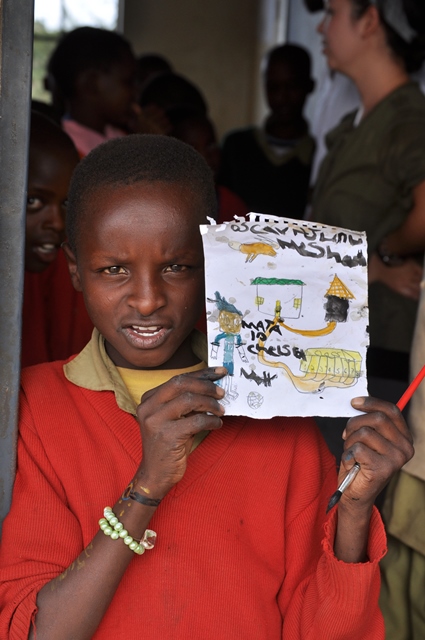
More recently, we have been helping out at the Il Polei Primary School in the after school Painting Club. Our ecological researcher, John Kenge, has been running the club for the last several years as practice for his future career in teaching. As art education is often missing from standard curriculum, the painting club offers students the chance to explore their artistic talents. They love the painting and adore John. He’s going to make a wonderful teacher one day soon!


Near the end of October we had a great visit from Jim Bleisner, a professor of Urban Planning at UC San Diego and artist, and Valerie Stallings, a retired councilwoman from San Diego (also see above for photos of Valerie dancing with the women of Twala).  We had a lot of fun with both Jim and Valerie with the baboons and in the area. Maybe the most special part of the visit was Jim doing a little art instruction in painting club. The students sat silently, all their attention focused on Jim and his instructions. The rest of us went around the room helping and praising the great work being done by the students.


Painting club is finished for the year, but we will resume again in January!


If anyone is interested in learning more about these community projects, please see: www.baboonsrus.com and www.conservationafrica.org

A day in the life of baboon researchers

Here’s a quick look at how we spend our days:

We are up by 5am, eating a quick breakfast and having the essential cup of Kenyan coffee. We pack lunch, fill our CamelBaks with water, and double-check our gear for baboon work. By 5:45 we’re on the road to see baboons, just as the sun is creeping over the horizon. Luckily that means that we get to see some spectacular sunrises.


And if we're lucky we get a nice clear view of Mount Kenya.

Lately we have not been so lucky, but have a pretty great view of the storms that are about to hit.

Regardless of the weather, after ~40 min in the truck we arrive in the area of our two focal troops. Although UNBP has six troops under observation year-round, we are focusing on the Pumphouse Gang and Enkai. Why only 2 of the troops? Successful behavioral field research results from a delicate balance in data collection. While we are always aiming to collect as much data as possible, we have to be careful to collect good quality data. In many cases in behavioral research, rich data on fewer individuals is actually better than sparser data on more individuals. We are currently just observing adults and sub-adults in our two troops, rotating through the individuals to get as even coverage as possible. Each day we go to the troop that we did not go to the previous day.


Once we have driven to the study area, we head to the target troop’s sleeping site. Each troop has a number of available sleeping sites in the area, mostly large rock formations that keep them safe from leopards, lions, and other risks at night. Each night we get texts from trackers on all troops as to where each troop goes for the night, so we have a pretty good idea where they will be in morning. That doesn't mean that the troop will be at the sleeping site when we arrive, some days the troop is off and moving by 6 am and it will take some time to find them and/or catch up. Usually we end up hiking 30-90 min to get to the troop, then we start our work day.


Our primary focus for data collection right now is social behavior. For each individual, we want to know who they are associating, grooming, fighting, and mating with. This will give us information about the relationships between individuals and, eventually, how they influence the overall dynamic of the group. 


To get this data we collect behavior in 3 ways: 
1. Focal follows: We follow one individual (our focal animal) for 15 minutes, recording everything that the focal does and the identities of all individuals that interact with the focal.
2. Nearest neighbor scans: We record the distances of the nearest male and female every 5 minutes for the focal animal during the focal follow.
3. Ad libitum behavior: Although it might not seem like it at first, baboons have a low rate of important social behaviors such as aggression and mating. If we only relied on focal follows, we would miss out on many of these interactions (I am beginning to think that the chances of a fight breaking out the minute after I finish a focal follow is way above chance). To give us a better picture of what is happening between individuals, we record every instance of these interesting social behaviors.  

All of this behavior is recorded on a handheld device in the field and uploaded into our computer databases each night at camp.


Getting back to our schedule, once we find the baboons, the observers split up and start collecting focal follows. Right now that is how we spend each day, just moving down our list of focal animals, getting as many focals as possible. I will admit that at times it can get a little boring. Some animals have a tendency to sleep or eat for entire focals and at times you have to wait for your focal animal to come down from a sheer rock face before you can even begin a focal. But there is always something interesting going on in the troop, it doesn’t take long before all observers become engrossed with the drama that is baboon society.  


Some of our latest news in the Pumphouse Gang is Buffalo’s new baby boy, Yankee. Buffalo is the highest ranking female in the troop, she is dominant over all other females. Anubis baboons, particularly females, are obsessed with babies. So the new arrival of Yankee has led to almost incessant baby greetings by all individuals that pass by Buffalo. Baby greetings often consist of a bow-like movement to get the greeter’s face close the baby, soft grunts, and lipsmacks. Not to anthropomorphize TOO much, but it is very much like my greetings to my baby nephews and seems to be just as addictive!


After filling 5-9 hours with behavioral observation on the baboons, it’s time to head home. We unpack and restock our materials, upload data, shower, deal with any camp maintenance or chores, and get to work making dinner. It is not normally too long after dinner that we are ready for bed. We need to get some good sleep in before starting another day of baboon research. 

Update from Kenya

First, sorry for the long gap in posts. I'm about to make up for it! Things in Kenya have been very busy getting everything sorted and running smoothly. We have finally settled into life here. For my first make-up post, here's what's been going on in our home life. Next I'll tell you about work and other parts of our experiences here. 

Laura and I have gotten completely settled to life in Anubisland. Laura has even pulled out her favorite T-shirt: 
                                            

And we have been getting a little too used to the normal wildlife around camp. These are some of the cool birds that are often hanging around (inside and out!):

Superb Starling

                                      
Female Marico Sunbird

                                     
We have a number of different weaver and sparrow species that hang around cleaning up scraps.

We also run into quite a bit of mammalian wildlife that has almost stopped being impressive to us...almost....

                                      
The Thomson's gazelles are everywhere in the area. 

                                      
We also often find mixed herds of gerenuk, impalas and gazelles, every once in a while they are joined by a giraffe for an almost complete Savannah experience. 

                                      
And let's not forget the herd of 60 elephants that we first saw roaming past our backyard and later saw bathing in this nearby dam. 

                                       
Of course the wildlife is not only around for us to see, sometimes they create quite the roadblock!

Last but not least, we have a new member of the family! This is Moo, our (hopefully) soon-to-be-effective anti-mouse system. She was awfully tiny when we got her:


But now she's growing into a cute, but mischievous part of our household. We just keep saying it's a good thing she's cute, otherwise her naughty business would be a problem.... And hopefully one day soon she's start carrying her weight around here and actually catch a mouse instead of going after our data sheets! 


That's it for home life, now on to baboon work!

Tuesday, October 1, 2013

Back in Ethiopia: A New Year, new Filoha

On September 11th we celebrated the Ethiopian New Year, it's now officially 2006!  For those of you who didn't know, the Ethiopian calendar runs differently than the Gregorian calendar that we use in the US. There are 13 months, 12 of which are exactly 30 days. And we're all 7 years younger while we are there (I must say, it's nice to be 23 again!).

Anyway, with the New Year in Ethiopia always comes the close of the rainy season. This means we still get to enjoy the lush greenery left by the rains, but no longer have to live like drenched cats in our tents anymore and the sun comes out to brighten our lives. The area is absolutely breathtaking:


As with any good New Year, we have some changes going on at Filoha. First, Sam Patterson has joined the team! Sam, yet another member of our University of Michigan alumni group at Filoha, came out in August and settled in quite quickly. She brought with her some mad problem-solving skills, a hilariously dry sense of humor, and huge passion for primates. So lucky to have another rockstar! 

We also got a new scout (here on the left). Esmale is a happy addition to the Filoha Family!


We've also seen some changes in baboon behavior - these baboons (not ours) have taken to sleeping on towers like this one far away from cliffs. It doesn't look comfortable, but it's pretty safe from lions and leopards! 

Our little baby warthogs are getting all grown up, here the kids are putting on their own muddy sunblock. What big kids!

Despite the large number of snakes we've seen this year, this is the largest live snake we have come across. This guy was over 2m long and happy to get out of our way when we drove by it on the road.  

This very handsome waterbuck has been hanging around Filoha for about a month now. He is the most majestic old guy we've seen in the area.

To celebrate New Year's  and my leaving for Kenya we went for a special dinner to the Awash Falls Lodge across the way. Before a delicious feast we went for a stroll down to the actual falls, it was gorgeous! 


We hadn't seen the baboons in a while, but of course they showed up right next to the road on my way out of Filoha. This was my last peek at them for the next 2 months: 


I'm going to miss my Filoha baboon, and non-baboon, buddies while I'm here in Kenya, 
but I'll be back there soon! 

A note from Nairobi

Apologies for not writing earlier, I arrived in Nairobi on September 18th from Ethiopia and planned on posting an update about Ethiopia before getting into the new Kenya project details. The first couple of days were non-stop running errands. Eric Vaughn, the first of the research assistants to arrive here, flew in on the evening of the 20th. That night we video chatted with his parents and girlfriend about his arrival and our plans for our time in Nairobi, they were so happy to see he was safe and sound and ready to start his first adventure in Africa.

The next day, as you likely know, the horribly tragic Westgate mall attack began across town. Eric and I were out at a different mall near our hotel getting some supplies and spoiling ourselves with frozen yogurt. Of course, the last thing we said to his family was we were taking it easy on Saturday, we were just going to the mall. We were completely safe the entire time, but it caused a little stress back stateside (sorry!). Once we realized what was going on (the incident was originally reported as a bank robbery gone bad) we bunked down in our hotel and watched with the rest of the world as the Westgate attack dragged on for more than 3 full days. All the locals around us just kept shaking their heads and telling us this was not right, not in Nairobi, this doesn't happen here. Several apologized to us because we were experiencing this in their country, they were embarrassed.

As seems to be the new response to terrorist attacks, the Kenyan people have risen up together, stronger and more united than they were before. They are grieving for those that were lost, but are making every effort to improve security across the country and return to normal schedules.

While Kenya continues to recover, we are also trying to restore Eric's African experience and get back to the business of baboon behavior. After some working days figuring out the logistics of a research project in Kenya,  we celebrated Eric's 23rd birthday in style. Apparently I was not feeding him enough protein since his arrival, so I made sure he got more than his share of protein on his day. We went to the famous restaurant Carnivore where we (but mostly he) was served beef, goat, lamb, chicken, ostrich, and even crocodile! This definitely brought a smile to his face:


Although meat-wise I only ate the chicken and tasted the ostrich (a lot like steak, if I remember correctly) and the crocodile (like chewy, slightly fishy chicken), we both partook in the African-inspired cocktails to celebrate his 23 years :)


That night we were joined by the second assistant, Laura Pena, who smiled bravely as she arrived in Nairobi just 3 days after the end of the Westgate siege. Still a little jet-lagged, Laura has already proven to be an excellent addition to our team. We have discovered that she and I share a lot of guilty pleasures (gin and tonics, SVU and more!) and she's already joining in on all of our fun here - we are really happy she came out.

So far both of these guys have been great additions to my own Kenyan experience. For a little fun amongst all the work we went to the Nairobi National Park Safari Walk (like a zoo). It was a great time and, of course, the main attraction for this crew was the the troop of baboons walking all over the raised viewing platforms. I can't wait to get out of Nairobi and show these guys our baboons up at Laikipia!